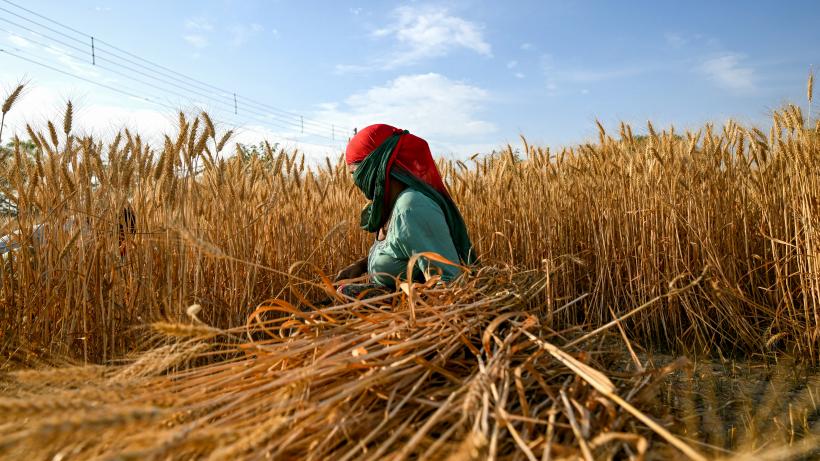
A farmer harvests wheat crop at a field in Faridabad on April 16, 2024. (Photo by MONEY SHARMA/AFP via Getty Images)
Shocks that settle: The long shadow of a commodity crisis
Rising tensions in the Middle East are disrupting more than just oil prices in emerging economies, where shocks to fertiliser and energy supply do not pass through - they settle. When critical inputs are disrupted, losses grow disproportionately, spreading through production chains and prices. Against the backdrop of this commodity crisis, fixing market distortions can improve efficiency and limit the amplification of future shocks.
For a farmer in Oromia or Punjab, a fertiliser shipment delayed by two weeks is not just late - it is useless.
Across much of sub-Saharan Africa and South Asia, planting windows are narrow and unforgiving, and fertilisers that arrive after they have passed are not used at all.
Roughly a third of global seaborne fertiliser and energy trade passes through the Strait of Hormuz, with several countries sourcing over a quarter of their supply from the region. Prices have responded quickly. Availability, more slowly. That gap is where the real damage lies.
The core mechanism behind amplifying commodity shocks
These shocks have cast long shadows on emerging economies. Energy and fertiliser are not inputs that firms or farmers can easily substitute away from. When prices rise, or deliveries fail, production does not smoothly adjust; it contracts abruptly. A missed fertiliser application not only lowers yields but also changes planting decisions, labour demand, and the viability of entire cropping cycles.
When a shock hits inputs that are both hard to substitute and deeply embedded across production processes, losses scale more than proportionally because the system cannot reallocate around them. The economy bends at first - and then parts of it simply stop. Because these inputs sit upstream, the effects propagate forward: lower output raises food prices, which compress real incomes, which feed back into demand for the next planting season. When households spend a large share of income on food and energy, that feedback loop is tight. The burden lands where adjustment margins are thinnest.
Distortions are not just a background condition. They are an amplifier. Even when the initial shock subsides, recovery can be slow because prices transmit unevenly. Domestic retail prices follow quickly when global prices rise, yet refuse to dance when global prices fall. Fragmented markets and thin competition give intermediaries room to widen margins on the way down - a classic rockets-and-feathers dynamic, enforced not by collusion so much as by structure.
Shocks are easy to import - but hard to unwind
What appears to be a temporary spike at the border can become a persistent wedge in the domestic economy.
These wedges cause lasting harm by warping the allocation of resources. When energy becomes both expensive and unreliable, firms shift to costly back-ups or exit production. In time, investment in energy-intensive or agricultural sectors dwindles. These are individually rational responses. In aggregate, they reduce output by more than the initial shock would suggest, because they push the economy further away from an already inefficient allocation.
This is why interventions that restore flow can matter more than those that trim prices. During a previous crisis in 2021-22, Sustain Africa mobilised fertiliser volumes and negotiated supplier rebates that kept inputs flowing to roughly two million smallholders. The point is not the tonnage. It is the counterfactual: in thin markets, access collapses before prices fully adjust, leaving farmers with neither inputs nor time to respond. Restoring flow through coordination, demand aggregation, or temporary trade facilitation can be more valuable than marginal price relief.
From a private shock to a public burden
When politics enters the room, however, government responses look different. Keeping prices of core commodities down is the sine qua non of survival. Subsidies, price controls, and the preferential allocation of energy inputs all feature prominently in crisis toolkits. These measures smooth the immediate shock, but also move it. A private input shock is converted into a public liability almost mechanically.
Pakistan’s recent experience makes this concrete. The surge in global gas prices following Russia’s invasion of Ukraine did not just raise input costs; it forced the government to absorb those costs through the energy system, widening fiscal pressures that later had to be unwound through sharp increases in electricity and gas tariffs. The shock was not avoided. It was deferred and placed on the public balance sheet, before returning in a more visible and painful form under an IMF programme.
Crisis response depends on structure
And yet, the instinct to subsidise critical inputs is not wrong. Lowering their effective cost can prevent sharp contractions in output and cushion immediate welfare losses. In systems where certain inputs have an outsized footprint - touching multiple sectors at once - the case for intervention is strong.
But the incidence of that intervention depends on the structure it enters. Where distribution is concentrated, subsidies can be captured upstream. Where markets are fragmented, they may not reach the farmers whose behaviour determines output. And where fiscal space is limited, they can crowd out the very investments that would reduce vulnerability to the next shock.
Crisis response and structural reform are therefore not separable. The value of fixing distortions lies not only in raising efficiency in normal times but in reducing the amplification when things go wrong.
The ongoing global commodity crisis shows that, in these economies, shocks do not pass through the system - they accumulate within it.