
BANGLADESH, DHAKA - JUNE 17 : The capital city of Dhaka. Textile factory in Savar, in the suburbs of Dhaka where work about six thousands employees. Dhaka is the capital of Bangladesh in June 17, 2015 in Dhaka, Bangladesh (Photo by Frédéric Soltan /Corbis via Getty Images).
Greening Bangladesh’s garment industry: Are we doing enough?
This webinar is part of LSE E-Week 2025.
Series
Readymade garments exports from Bangladesh to Europe crossed £16.5billion in FY242, running a close second to China. But how much of it is sustainable? The RMG industry is one of the most polluting in the world. The process of producing cotton and transforming it into clothing is extremely water-intensive. Dying and finishing of garments generate large amounts of wastewater - raising concern in a country with limited regulation enforcement capacity. In addition to all this, Bangladesh's textile industry is highly energy-intensive and heavily reliant on gas-based power production.
Bangladesh must act now to save its environment and, also save the industry. There is growing environmental consciousness among consumers that has forced the brands to promise a cleaner production process. The EU is also set to punish carbon-intensive imports through its Carbon Border Adjustment Mechanism policy that may include textiles in the near future. Limiting environmental damage may also help Bangladesh get the GSP+ trade facility- something the factory owners say is crucial for the industry.
In this session, we will explore how Bangladesh’s RMG industry is beginning to confront these challenges—through cleaner water use, wastewater treatment, and renewable energy adoption. More than just a question of compliance, this is about reimagining the industry’s future: protecting the environment, meeting global standards, and ensuring Bangladesh remains a leader in the world’s garment trade.
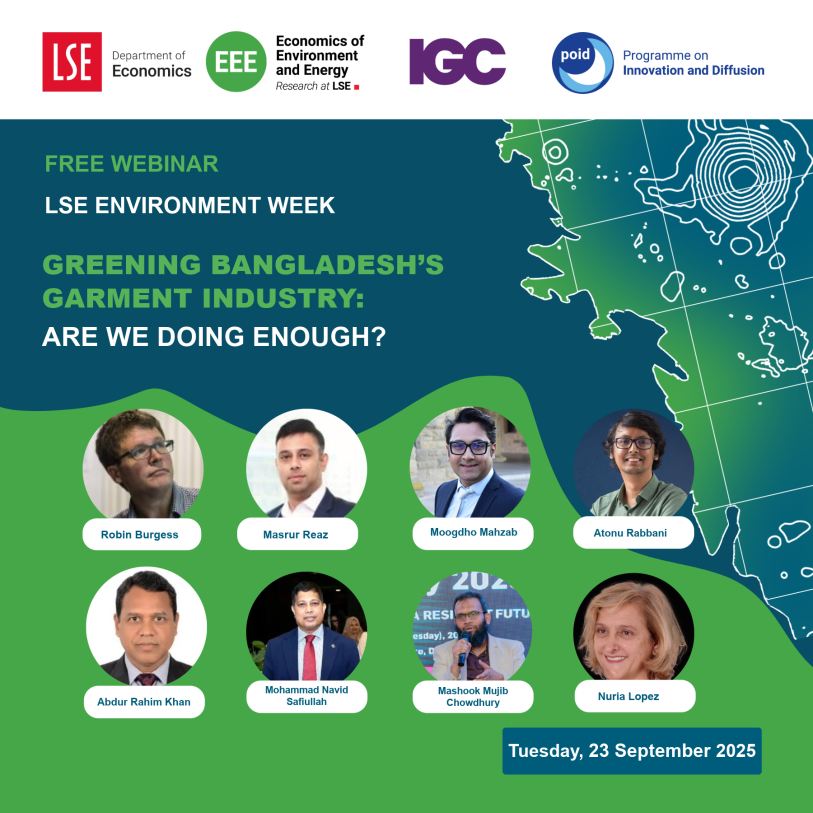
A graphic for the Bangladesh Webinar during E-Week 2025
Watch a recording of the webinar below:


Presentation 1: Does trade with multinationals induce greener production? Evidence from the Bangladesh fashion industry

Presentation 2: Exploring the Adoption of Renewable Energy Technology (RET) among Apparel Exporters in Bangladesh

Panel Discussion

Md. Abdur Rahim Khan
Additional Secretary (Head of Export Wing), Ministry of Commerce, Bangladesh
Mohammad Navid Safiullah
Additional Secretary, Bangladesh Ministry of Environment, Forest and Climate Change
Mashook Mujib Chowdhury
Senior Manager, Sustainability, DBL Group