
A photo of Chetan Ghate (Director of the Institute of Economic Growth in New Delhi) and others in attendance at a conference held in India by the ISGH.
From risk to resilience: Helping people and firms adapt in South Asia by Dr Siddharth Sharma (Lead economist, World Bank)
As global temperatures continue to rise, developing regions are facing increasing climate risks. The UNEP Adaptation Gap Report 2025 – Running on Empty highlights the widening gap between the funds needed for climate adaptation and the resources currently available. South Asia faces unique challenges as limited government capacity forces households and businesses to shoulder much of the adaptation burden. This talk explores how the region is responding, the barriers to effective adaptation, and the urgent actions needed to strengthen resilience for the future.

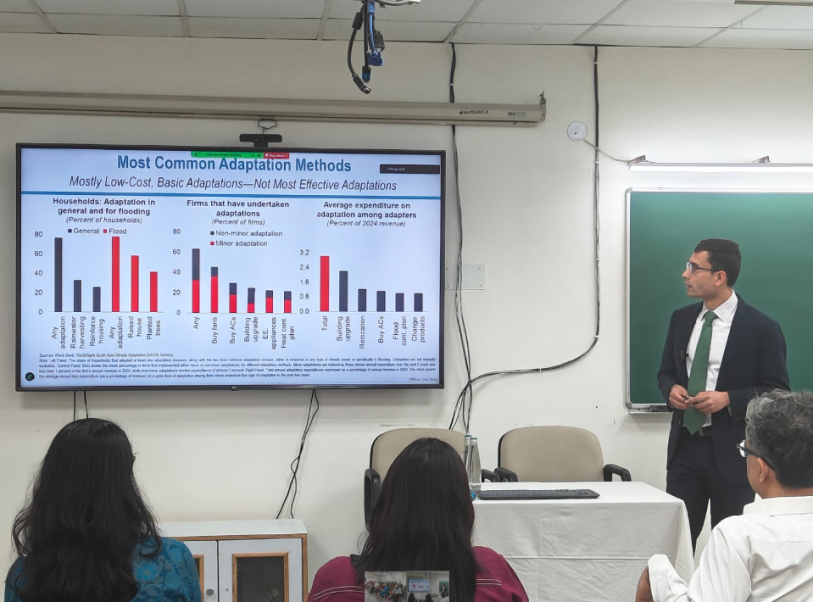
ISGH Risk to Resilience Event featuring Dr Siddharth Sharma (Lead Economist, World Bank)
South Asia is the most climate-vulnerable region among emerging markets and developing economies. With governments constrained by limited fiscal space, the responsibility for climate adaptation will largely fall on households and firms.
This report finds that households and firms in South Asia are aware of climate risks—over three-quarters expect to experience weather-related shocks within the next decade—and are already taking steps to adapt. However, most rely on basic coping strategies. Market imperfections continue to limit access to the information, finance, and technologies required for more effective adaptation.
If these barriers were removed, private sector adaptation could offset roughly one-third of the potential economic damage from rising global temperatures. The report concludes by outlining key policy priorities for governments to facilitate adaptation, strengthen resilience, and enable inclusive climate action across the region.
What is ISGH?
The Centre for Research on the Economics of Climate, Food, Energy and Environment (CECFEE) at the Indian Statistical Institute (ISI), Delhi and IGC at the London School of Economics and Political Science (LSE) co-established the India Sustainable Growth Hub (ISGH) in 2024.
ISGH brings together ISI’s domestic expertise and IGC’s global policy and research ecosystem to generate high-quality evidence for India’s transition to sustainable growth. The collaboration was made possible by funding from the Bezos Earth Fund.