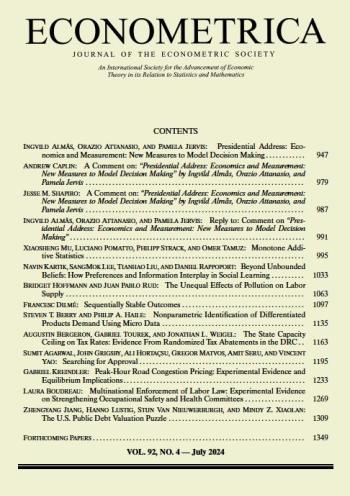
Peak-hour road congestion pricing: Experimental evidence and equilibrium implications
This journal article, published by Econometrica, examines policies to alleviate road traffic congestion in Bangalore. See the full abstract below for details.

Abstract: Developing country megacities suffer from severe road traffic congestion, yet the level of congestion is not a direct measure of equilibrium inefficiency. I study the peak-hour traffic congestion equilibrium in Bangalore. To measure travel preferences, I use a model of departure time choice to design a field experiment with congestion pricing policies and implement it using precise GPS data. Commuter responses in the experiment reveal moderate schedule inflexibility and a high value of time. I then show that in Bangalore, traffic density has a moderate and linear impact on travel delay. My policy simulations with endogenous congestion indicate that optimal congestion charges would lead to a small reduction in travel times, and small commuter welfare gains. This result is driven primarily by the shape of the congestion externality. Overall, these results suggest limited commuter welfare benefits from peak-spreading traffic policies in cities like Bangalore.